English
 Français
 Español

Sep 27,2026
The Dehydrated Vegetable Market in 2026: Scale, Traction, and What Buyers Need to Know
Global demand for dehydrated vegetables keeps climbing, but market estimates vary far more than the headlines suggest. For food manufacturers and procurement teams, the real question is not just how large the market is, but which suppliers can deliver consistency at scale.
Three things are true about the dehydrated vegetable market in 2026. It is growing, more fragmented than the headline numbers suggest, and harder to buy well. Soup mixes, seasoning blends, ready-meal kits, and plant-based formulations now rely on dehydrated vegetables as structural ingredients, not garnish. The supplier's growing practices, drying technology, and quality systems have a direct impact on flavor, texture, and shelf stability.
A Multi-Billion-Dollar Market, Read with Care
Published market estimates for dehydrated vegetables vary widely. One 2026 report sizes the global market at USD 7.49 billion, another at USD 18.46 billion, and a third above USD 80 billion. This spread is not a calculation error; it reflects different definitions of product scope, forms, and distribution channels. What nearly every forecast shares is the direction: sustained growth at roughly 4 to 6 percent annually through the early 2030s.
For planning purposes Use market reports for direction, not precision. A 2-point difference in CAGR between reports can change capacity decisions.
| Report (2026) | Base value | Projected value | Implied growth |
|---|---|---|---|
| Fortune Business Insights | USD 7.49 billion (2026) | USD 12.94 billion (2034) | ~7% CAGR |
| The Business Research Company | USD 18.46 billion (2026) | USD 23.54 billion (2030) | ~6% CAGR |
| IMARC Group | USD 82.1 billion (2025) | Not disclosed | ~4% CAGR |
The more important number is the share of trade that is business-to-business. Dehydrated vegetables are overwhelmingly food-industry inputs rather than retail staples. A consumer story about dried vegetable snacks is not a procurement forecast for soup and seasoning manufacturers. Check whether a report distinguishes by form, end-use, and distribution channel before setting inventory strategy.
What Is Driving the Next Growth Cycle
Convenience without the compromise
Ready meals, instant noodles, seasoning sachets, and meal kits need vegetables that rehydrate quickly and hold their shape. Dehydrated vegetables provide the taste and nutritional profile of fresh produce with no peeling, chopping, or cold-chain handling. As energy and logistics prices have risen, dehydration has become the default choice for many shelf-stable lines.
Plant-based and clean-label formulation
The plant-based food sector has become a large-volume buyer of dehydrated vegetables for the structure, color, and umami they contribute to meat analogues and ready meals. At the same time, clean-label pressure is pushing manufacturers to replace artificial colors and flavor enhancers with concentrated vegetable ingredients. Tomato, red beet, spinach, and carrot are increasingly specified for their natural coloring and flavor properties.
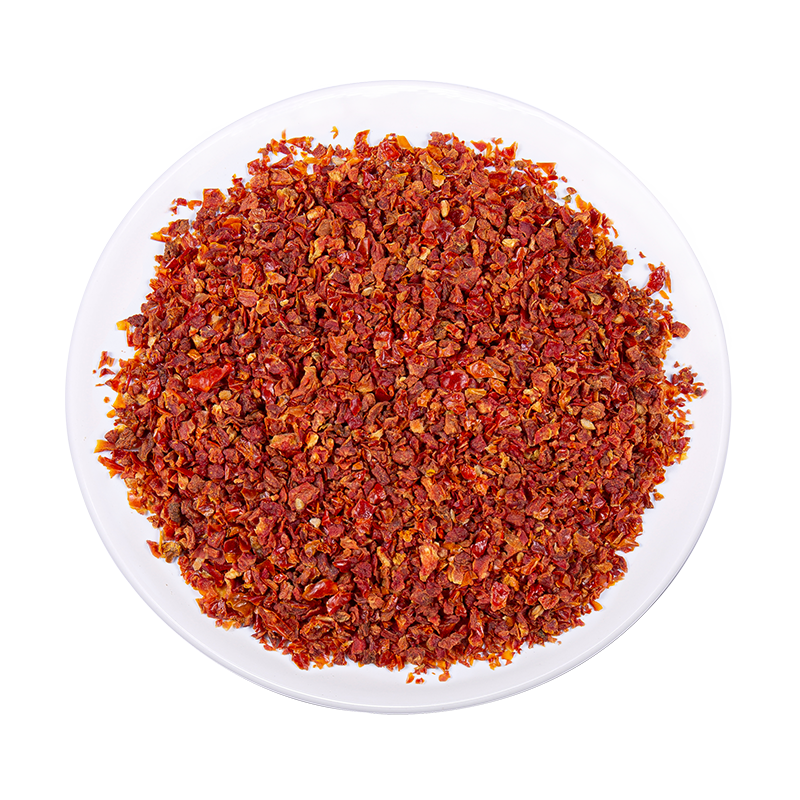
 Dehydrated Tomato Flakes, Dice, Granules, and Powder from Xinghua Jiahe FoodsThis air-dried tomato line supports natural color and flavor in plant-based meals and clean-label formulations. Its HACCP-compliant processing and hand-sorting controls make it a practical option for manufacturers seeking consistent, shelf-stable tomato ingredients.View Product →
Supply chain resilience
The years since the pandemic reshaped how food manufacturers think about single-source dependencies. Dehydrated vegetables answer that concern directly: they can be produced in one region, stored for months without refrigeration, and shipped long distances with minimal spoilage risk. That flexibility matters when cold-chain chokepoints appear or fresh harvests underperform.
Product Segments and Forms: What Buyers Are Specifying
Different applications call for different forms. Flakes rehydrate quickly and work well in soups; powders blend cleanly into dry seasoning mixes; granules and dices suit ready meals and snack seasonings. The category is moving away from commodity thinking toward specification-based purchasing, where particle size, rehydration ratio, moisture content, and microbiological limits are defined at the contract level.
- Soups and broths: flakes and fine granules for rapid rehydration
- Seasoning blends: powders and minced forms for uniform dry mixing
- Ready meals and side dishes: dices and larger flakes for visual identity
- Bakery and snack coatings: fine powders with defined color intensity
- Plant-based meat analogues: texture-specific dices and fiber pieces
Onions remain the largest single product category in most market breakdowns, found everywhere from broths to instant noodle seasonings. The practical specification for a buyer is less about the vegetable itself than about consistent particle size, rehydration behavior, and processing method.
Dehydrated Onion Flakes, Dice, Granules, and Powder from Xinghua Jiahe FoodsA widely used onion ingredient offering controlled particle size and reliable rehydration for soups, seasonings, and prepared meals. The supplier’s HACCP-based processing and 300-person sorting line underline the quality checks behind this convenient, long-shelf-life flavor base.View Product →
For a closer look at how a single ingredient moves from field to formulation, our review of dehydrated carrot applications covers the use cases, quality parameters, and selection logic that food manufacturers apply in practice.
The certificate is a snapshot. The rehydration test is the truth.
How to Vet a Dehydrated Vegetable Supplier
Market reports frame the opportunity; they do not tell you which factory can hold a half-millimeter particle-size tolerance across two different harvest seasons. For a food manufacturer, supplier diligence always comes down to one granular question: can this supplier replicate the same specification batch after batch, across different production lines, through year-round demand?
Certifications are the first filter. BRC A-level or A+ certification, for example, signals a tested food safety management system reviewed by an external auditor. But a certificate is a baseline, not proof of everyday execution.
Common pitfall Do not evaluate a supplier on certificate alone. The distance between an audited quality system and the product actually shipped is bridged by sampling: rehydration tests, sieve analysis, microbiological specifications, and a controlled pilot run.
Vertical integration matters. Suppliers who control raw-material planting and harvest scheduling are better positioned to manage pesticide residues, size variation, and microbial risk. A factory with its own base planting, like those serving the Inner Mongolia pepper and tomato lines, can lock in freshness and consistency far more effectively than a broker consolidating from multiple farms.
Dehydrated Green Bell Pepper Flakes, Dice, Granules, and PowderThis dried green pepper fits seasoning blends, sauces, soups, and ready meals while complementing a vertically integrated sourcing strategy. Its HACCP-compliant production and hand-sorting stage help maintain consistency, making it worth reviewing when assessing capacity and supplier control.View Product →
Capacity discipline is just as important. A supplier that expanded ahead of demand differs from one running at full utilization and taking on orders it cannot comfortably fulfill. Ask about current capacity use, forward slots, and how peak-season rush orders are handled.
What works Buyers who treat sourcing as a technical partnership, sharing rehydration targets and end-product performance requirements with the supplier, consistently get better batch-to-batch stability than those who negotiate price alone.
Before signing a long-term agreement, review the supplier's own production and quality documentation and audit the facility if the order volume justifies it.
Regional Dynamics: Processing Moves Closer to the Farm
One clear recent shift is the move to site dehydration capacity in the regions where raw materials are grown. In China, processors have expanded into Inner Mongolia for peppers, tomatoes, pumpkins, and onions. The shorter the distance between field and drying line, the easier it is to lock in freshness, manage residues, and control the moisture profile that determines rehydration performance.
China remains the world's largest exporter of dehydrated vegetables, and its processing base is consolidating around a smaller number of larger facilities with export-grade certifications. Many international food manufacturers are reducing the number of suppliers they manage, concentrating volume in factories that can deliver both a broad product range and consistent execution.
The Next Five Years
Three shifts will define the market through 2030. First, form diversification: powders and fine granules will grow faster than coarse flakes. Second, transparency: buyers will demand deeper documentation on growing practices, traceability, and processing parameters, and will pay for it. Third, professionalization: certified factories with disciplined capacity planning will capture a growing share.
Risk to manage Procurement teams that treat dehydrated vegetables as a low-risk commodity and skip batch-level quality testing are increasingly exposed. Food safety standards are tightening, and a single non-conforming batch in an exported container can stop a supply line for weeks.
The 2026 market is not simply a bet on vegetable consumption; it is a bet on the industrialization of food processing. Suppliers who can demonstrate reliability at scale, robust food safety systems, and honest capacity planning will be the ones that matter over the next cycle.
One final note for buyers: watch the specification, not just the price. The market's growth is real, but its economics are nuanced. A low price per tonne loses its appeal when rehydration yield falls, particle size drifts, or a contaminated batch triggers a recall alert. Suppliers who understand how their products behave inside a commercial formulation deliver value that the price sheet alone will never show.