English
 Français
 Español

Oct 08,2026
Dehydrating Whole Chili Peppers: Slow, Solvable, and Worth Getting Right
Whole pods keep their shape, their seeds and their aroma. What they refuse to do is give up water quickly, so the real work happens in the first two minutes of preparation.
Five kilos of cayenne come off the plants in one October afternoon, and the dehydrator has four trays. The obvious move is to load the pods whole, stems and all, and check them in the morning. That works, but only if you plan around a simple fact: a chili pepper is built to keep water inside. The waxy cuticle that protects the fruit on the plant does exactly the same job inside a drying chamber, and a whole pod gives moisture no cut surface to leave from.
The Short Answer: Whole Pods Dry, Just Two to Three Times Slower
Whole chili peppers do dry successfully. Expect two to three times the drying time of halved pods, a wider spread between the fastest and slowest pod on the tray, and a real mold risk if one soft spot survives the cycle. Piercing each pod with a skewer, or running a short slit down one side, roughly halves the time and costs about two minutes per tray.
Wall thickness decides most of the outcome. Thin-walled types such as cayenne, Thai bird and arbol dry whole with a single slit and still finish inside a working day. Thick-fleshed pods such as jalapeno, Fresno and poblano hold much more water and dry far less evenly, so halving them lengthwise is the safer route whenever the shape of the finished pod does not matter.
Whole pods are not a harder way to dry chilies. They are a slower way, and the difference ends up in the colour, the texture and the risk of a ruined jar.
Warning: air that is too hot dries the outside of a whole pod before the inside, sealing moisture behind a hard shell. That is case hardening, and it is the most common reason a batch that feels crisp turns soft and furry two weeks later.
Preparing Whole Pods So Moisture Can Leave
- Sort first. Set aside split, bruised or soft pods; one leaking pod can spoil a full jar.
- Rinse quickly, then dry the surface. A little water is not the enemy, but it slows the first hour.
- Decide what happens to the stem. Leaving it on looks better in a jar but blocks the easiest exit route, so trim it to about 5 mm or remove it.
- Open the pod. Push a skewer through the wall two to four times, or cut one slit 1 to 2 cm long along the side, aiming into the seed cavity rather than straight through both walls.
- Consider a short blanch. Thirty to sixty seconds in boiling water, then an ice bath, breaks down the cuticle and shortens drying at the cost of some colour and aroma.
- Load in a single layer with visible gaps, keep trays apart, and rotate them top to bottom halfway through.
Temperature, Time and Tolerance
The usable range for peppers is narrow. Below roughly 95 F (35 C) drying stalls and mould gains ground; above 165 F (74 C) you are cooking the pod rather than drying it, and the colour dulls within an hour. Most dehydrators do their best work between 125 F and 145 F (52 C to 63 C), and the right setting depends on how much of the pod you have opened up.
| Form of the pod | Air temperature | Typical drying time | Main risk |
|---|---|---|---|
| Whole, stem left on | 125-135 F (52-57 C) | 10-16 hours | Case hardening; moisture trapped near the stem |
| Whole, pierced or slit | 130-140 F (54-60 C) | 8-12 hours | Uneven interior in thick-walled pods |
| Halved lengthwise | 135-145 F (57-63 C) | 5-8 hours | Scorched edges on thin walls |
| Sliced or diced | 135-145 F (57-63 C) | 3-5 hours | Pieces that shatter when handled |
Two variables stretch these numbers more than anything else: weather and altitude. A humid week can add three or four hours, and thinner air at elevation slows drying even when the temperature reading is unchanged.
Proving the Pod Is Dry, Then Storing It Without Mold
Done test: a fully dried chili snaps when bent, the seeds rattle inside, and the thickest part of the pod cracks instead of flexing. If it bends like leather, it is not finished.
Aim for 6 to 8 percent moisture, with 10 percent as the practical ceiling. Breaking open the thickest pod and checking for cool, soft tissue near the stem is enough for a home batch; a producer will weigh a sample, dry it further and weigh it again to see exactly how much water was left behind.
Condition the batch before sealing it. Fill a jar loosely, leave the lid on and shake it once a day for five to seven days, so any remaining moisture equalises through the whole batch. Fogging on the glass, clumping or a faint musty smell all announce themselves during that week. Only afterwards should the pods go into airtight containers with an oxygen absorber, stored dark and cool.
Danger: grey fuzz, dark patches or a musty smell means the whole container goes, not just the pods you can see. Mold spreads through a batch long before it becomes visible.
Mistakes That Waste a Batch
- Stacking trays too close, which traps humid air in the middle of the stack.
- Turning the dial to maximum to save an hour, which cooks the surface and leaves the centre wet.
- Sealing pods while they are still warm, which condenses water inside the jar.
- Mixing thick and thin-walled varieties on one tray, so half the batch scorches while the other half stays damp.
- Storing clear jars in daylight, where colour and aroma fade within weeks.
From a Kitchen Tray to a Tonne of Pods: What Changes at Factory Scale
The physics does not change with volume; the control does. An industrial line still has to give water a route out of the pod, so whole chilies are perforated, slit, or cut into halves and flakes before they enter the dryer. Pods travel through a multi-stage hot-air tunnel or belt dryer that starts around 60 to 75 C and steps down to cooler finishing zones, so the outside dries slowly enough for the interior to follow. Belt depth is the quiet variable: a few extra centimetres of pods on one side of a belt produces two different moisture readings in the same batch. Most food manufacturers never build that line themselves, and buy instead from a dehydrated vegetable supplier that runs it all year.
What leaves the factory is not a technique but a specification: moisture between 6 and 8 percent, colour measured in ASTA units, heat level stated with a tolerance band, stem-on or stemless pods, flakes at a defined mesh, and microbiological limits held well inside the legal maximum. The difference between dehydrated and dried vegetables matters here, and it is worth understanding before it appears in a contract.
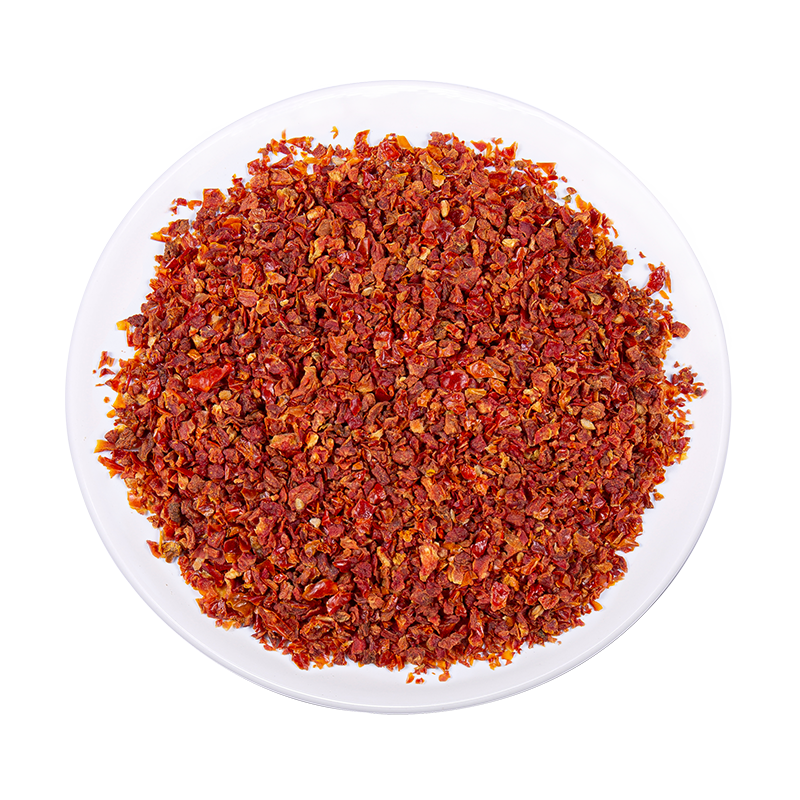
Chili varieties are a normal part of that supply. Thin-walled red pepper can still be dried as whole pods with a single slit, jalapeno almost always arrives halved or diced because of its water load, and green pepper follows the red pepper route at a lower temperature to protect its colour.
What a Pepper Specification Should Cover
A dozen lines on a spec sheet decide whether a pepper shipment behaves in your process. These are the ones worth locking down before the first order.
- Moisture content, plus the method used to measure it. Most pepper specs sit between 6 and 8 percent, with 10 percent as the outer limit.
- Colour, expressed in ASTA units for red pepper and as chlorophyll retention for green.
- Heat level, in Scoville heat units or as a capsaicin percentage, with a tolerance band rather than a single figure.
- Variety and origin, because cayenne from one region is not interchangeable with arbol from another.
- Stem status and cut size: whole pods with stems, stemless pods, halves, 3 to 5 mm flakes, 20 to 40 mesh powder.
- Food safety documentation: certification level, microbiological limits, pesticide screening, metal detection and traceability back to the growing block.
Red pepper is the clearest example of why the numbers matter. The same variety dried twenty degrees hotter can lose several ASTA units of colour, which costs the buyer far more than the price gap between two suppliers.
Drying whole chili peppers is a slow method with a narrow margin, and that is exactly why it rewards attention. A slit in the pod, a steady 130 F, and a week of conditioning turn a risky batch into a dependable one. At industrial scale, those same three ideas reappear as a perforation standard, a temperature profile and a moisture specification, which together decide whether the pepper in the bag still tastes like the pepper that came off the plant.