English
 Français
 Español

Oct 08,2026
Dehydrated vegetable chips · technique and tolerance
Dehydrating Vegetables for Chips: Slicing, Temperature and Crisp Texture
Most dehydrators can dry a tray of vegetables. Far fewer produce chips that still snap twenty minutes later in a bowl, and the machine is almost never the reason.
Picture a batch of 4 mm beet slices coming out of the dehydrator after nine hours. They look glossy, firm and finished. Left on the kitchen counter, they turn leathery within half an hour. The same beet, cut at 1.5 mm and dried at the same temperature, stays brittle for a week.
The difference is residual moisture and cell structure. Vegetable chips turn crisp when moisture falls to roughly 3 to 5 percent and water activity drops below about 0.4. Above that threshold, pectin and starch keep pulling humidity out of the air until the slice bends instead of breaking.
Three practical decisions follow from that single fact: how you cut the vegetable, how you pre-treat it, and how you store it. Seasoning is the easy part.
Choose Vegetables That Hold Their Shape
Not every vegetable becomes a chip. Water content and starch content decide whether a dried slice shatters or chews, and the categories are consistent enough to plan around.
- Starchy roots such as sweet potato, potato and beetroot: dense tissue, clean fracture when fully dried.
- Firm roots and bulbs such as carrot, parsnip, radish and onion: moderate sugar, reliable snap, slight curl at the edge.
- High-water vegetables such as zucchini, cucumber and tomato: they lose more than nine tenths of their volume and turn papery unless salted and pressed first.
- Leafy greens such as kale and cabbage: these shatter rather than snap, which is why they are sold as crisps instead of chips.
Uniformity matters more than variety. A tray holding 1 mm and 4 mm slices at the same time will always give two results: scorched edges and a soft centre. A mandoline locked at 2 mm solves more problems than any dehydrator upgrade.
| Vegetable | Water content | Slice thickness | Dried behaviour |
|---|---|---|---|
| Beetroot | About 87% | 1.5 to 2 mm | Glassy, deep colour, cracks cleanly |
| Sweet potato | About 77% | 2 to 3 mm | Holds shape; best blanched first |
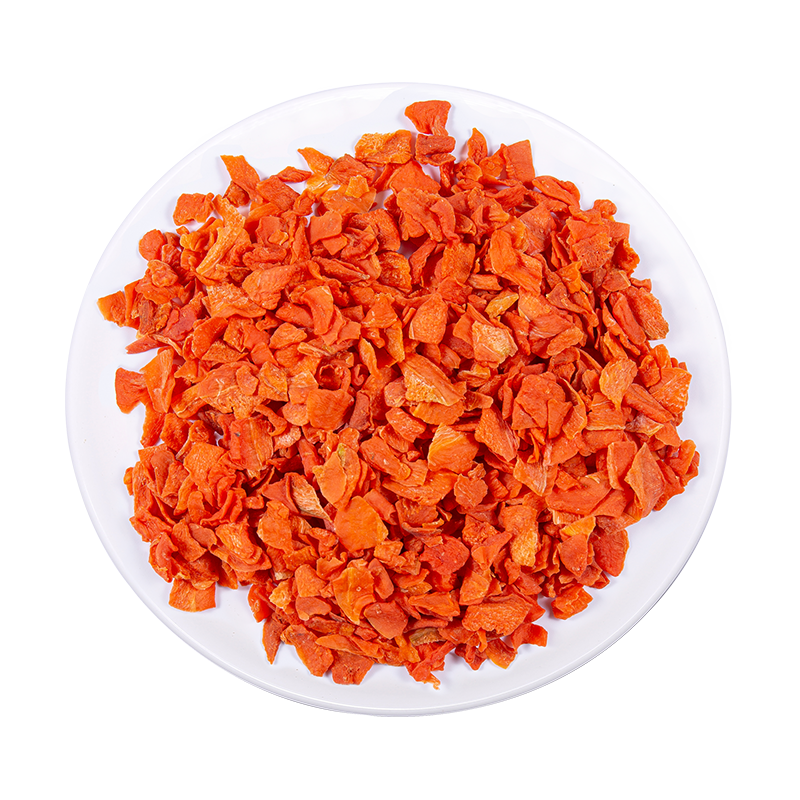
| Carrot | About 88% | 2 mm | Sweet, crisp, mild curl |
| Zucchini | About 94% | 3 mm | Shrinks sharply; papery unless salted |
| Kale | About 84% | 3 cm pieces | Shatters; brittle in three to four hours |
| Apple | About 86% | 2 to 3 mm | Sweet chip; browns without pre-treatment |
If you are starting out, carrot and beetroot are the most forgiving pair: dense enough to slice cleanly, sweet enough to eat with nothing on them.
Blanching, Starch and the Raw Potato Problem
Raw slices will dry, but they do not always develop a glassy, brittle structure. The reason is starch: in raw tissue, starch granules sit inside intact cells and hold water tightly, so the outside dries long before the inside is ready.
Blanching for two to three minutes in boiling water, followed by an ice bath, changes that. It gelatinises surface starch, deactivates the enzymes responsible for browning, and opens cell walls so moisture migrates out faster. Carrot, beetroot and sweet potato all benefit, and the slices keep more colour afterwards.
Dry enough to bend is not dry enough to break. A chip that bends has already failed.
Potatoes are the classic exception. A raw potato slice dried at home usually ends up flexible, slightly translucent and chewy, because the starch network is too tight for a domestic dehydrator to break. That is why commercial potato chips are fried rather than dried, and why sweet potato, with its looser structure, is the more practical tuber to begin with.
Temperature, Time and the Snap Test
Temperature does two jobs at once: it drives evaporation and it sets the ceiling on colour, flavour and safety. Two ranges cover almost every home batch.
- Slice to 1.5 to 3 mm with a mandoline and discard the tapered ends, which dry before the middle does.
- Blanch starchy or browning-prone vegetables for two to three minutes, cool in ice water, then pat dry.
- Arrange in a single layer with space between slices; overlap creates wet spots that never catch up.
- Set 52 to 57 degrees Celsius when flavour and colour matter most, or 60 to 68 degrees when speed and microbial safety matter more.
- Rotate trays top to bottom every two hours; most home units dry unevenly front to back.
- Snap-test a cooled slice, never a warm one, which is always softer than it will be.
- Condition the batch in a sealed jar for 24 hours, then re-dry for 30 to 60 minutes if any slice has softened.
Expect six to twelve hours for roots cut at 2 mm, three to five hours for leafy greens, and longer for anything thicker than 3 mm. Time is an output, not an input: slice thickness and tray load decide it.
Success marker: a properly dried carrot chip breaks with a short, dry crack and leaves no moisture on the fingertips.
Seasoning Without Softening the Chip
Salt is a moisture magnet. Added before drying, it draws water to the surface, slows the process and leaves the chip slightly tacky. Added afterwards, it seasons cleanly and changes nothing about texture.
A very thin film of oil, roughly one teaspoon per tray tossed through and then rubbed off, gives powders something to cling to. More than that and the surface oxidises, which shortens shelf life and leaves a stale note within weeks.
The most useful seasoning ingredients are dried vegetables themselves. Tomato, onion, garlic and beet powders deliver savoury depth, colour and gentle acidity without adding sugar, and they blend well with a little salt and smoked paprika.
Beetroot deserves its own note: the betalain pigment is heat-sensitive, so batches dried above roughly 60 degrees fade from crimson to brown. Lower and longer keeps the colour that makes beet chips worth the effort.
Acid needs a follow-up pass. If you mist chips with vinegar, return the trays to the dehydrator for another 20 to 30 minutes, or the surface picks up moisture and the batch softens overnight.
Storage Is Where Most Batches Lose Their Crunch
Chips must cool completely before they are sealed. Warm slices release steam into the container, and that steam condenses on the lid and rains back onto the batch.
- Airtight glass jars or metallised pouches; a zip bag alone is not a moisture barrier.
- An oxygen absorber for anything stored longer than a month.
- A jar-in-vacuum approach for brittle chips, which crush easily under full vacuum.
- Storage below 24 degrees Celsius, away from light and away from the oven or dishwasher.
If condensation appears inside the container within 24 hours, the batch was not dry enough. Return the slices to the dehydrator for another hour and test again.
Dried to 3 to 5 percent moisture, sealed airtight and kept cool, vegetable chips hold their texture for six to twelve months. In a humid kitchen that estimate drops quickly, which makes a one-day check the cheapest insurance you can buy.
From a Countertop Tray to a Production Line
The variables do not change at industrial scale, but the tolerances do. A home cook can live with a slice that measures 2.4 mm on one edge. A snack manufacturer cannot, because the same deviation that makes one chip soft makes another one scorched.
Commercial specifications typically fix slice thickness within a few tenths of a millimetre, moisture content inside a narrow band, and water activity low enough to keep a finished snack crisp through a nine to twelve month shelf life. Colour is specified as well, which is why lower drying temperatures are standard for beet and tomato. If the terminology gets blurry during sourcing, this comparison of dehydrated and dried vegetables is a useful starting point.
Volume suppliers build capacity around specific crops rather than around a single product. Xinghua Jiahe Foods, a dehydrated vegetable supplier running two plants, holds roughly 4,000 to 5,000 tonnes of annual capacity at its Jiangsu site and 2,000 to 3,000 tonnes at its Bayannur site in Inner Mongolia, with BRC A+ certification renewed in 2024 and a third expansion due for completion at the end of 2026. That split matters to chip makers: pepper, tomato and pumpkin come from the northern plant, while carrot, onion and sweet potato are processed in Jiangsu.
Chips are a moisture problem dressed up as a flavour problem. Slice evenly, pre-treat anything starchy, dry to a genuine snap rather than an optimistic bend, and seal the batch only after it has cooled completely.
Get those four steps right and seasoning becomes a preference rather than a rescue mission, and a tray of carrot or beetroot chips will outlast the bowl you put them in.