English
 Français
 Español

May 25,2026
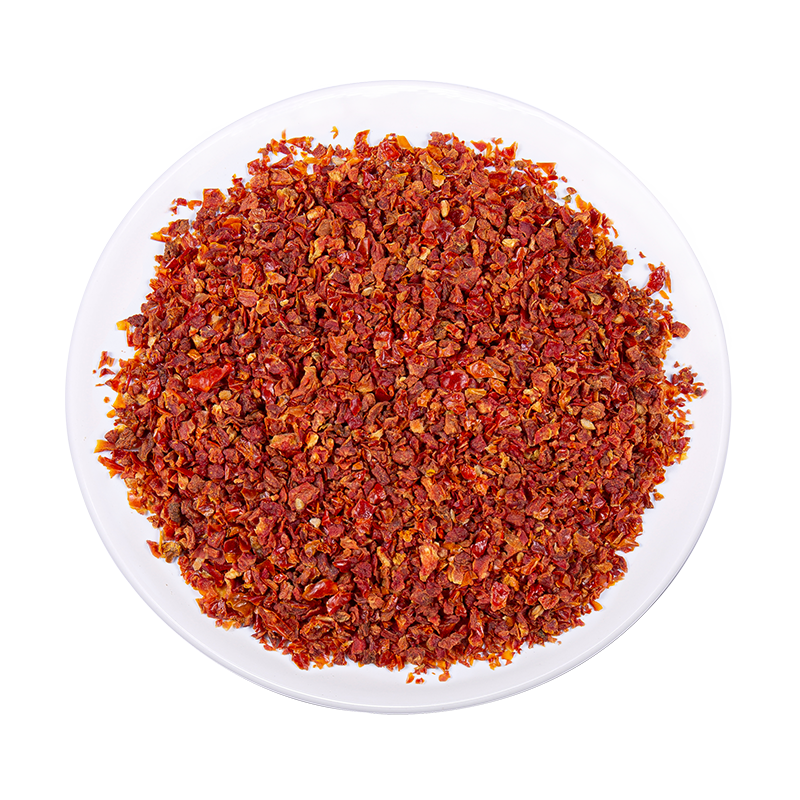
Dehydrated Tomato performs best when a structured texture and slow flavor release are needed, while tomato flakes excel in quick hydration and visual appeal, and granules are most effective for uniform flavor dispersion in sauces and soups.
Compared to flakes and granules, dehydrated tomato retains more intact cellular structure, resulting in more authentic tomato bite after rehydration, but it requires slightly longer preparation time.
Structural Differences Between Dehydrated Tomato, Flakes, and Granules
The main difference between dehydrated tomato forms lies in particle size and drying method. Whole or chunk-style dehydrated tomato is typically produced using controlled hot-air systems or advanced food dehydrator sun dried tomatoes processes, preserving fibrous structure.
Tomato flakes are thinly sliced and rapidly dried, making them fragile and fast to rehydrate. Granules are mechanically ground, producing fine particles that dissolve quickly into liquid-based meals.
- Dehydrated Tomato: large pieces, slow hydration, strong texture retention
- Tomato Flakes: medium structure, moderate hydration speed
- Tomato Granules: fine powder-like form, fastest dispersion
Performance in Ready-to-Eat Meals
Ready-to-eat meals demand stability, flavor retention, and fast rehydration. In this context, dehydrated tomato provides a more “authentic bite experience,” especially in rice bowls, pasta meals, and freeze-dried camping foods.
Dehydrated Tomato Advantages
- Better texture integrity: maintains chewable structure after rehydration
- Flavor layering: releases taste gradually during heating
- Visual appeal: resembles fresh tomato pieces more closely
Flakes and Granules Advantages
- Fast hydration: ideal for instant soups and sauces
- Uniform mixing: granules dissolve evenly in liquid meals
- Cost efficiency: easier and cheaper to produce at scale
Rehydration Speed and Functional Efficiency
Rehydration time is critical in ready-to-eat systems. Dehydrated tomato generally requires 8–15 minutes depending on water temperature, while flakes rehydrate in 3–6 minutes and granules dissolve almost instantly.
In industrial applications using food dehydrator sun dried tomatoes, controlling moisture content to below 8% ensures better shelf stability but slightly slower rehydration.
| Form | Rehydration Time | Texture Quality | Best Use Case |
|---|---|---|---|
| Dehydrated Tomato | 8–15 min | High structure retention | Premium meals |
| Tomato Flakes | 3–6 min | Moderate softness | Soups, noodles |
| Tomato Granules | Instant | Fully dissolved | Instant sauces |
Flavor Retention and Culinary Applications
Flavor retention is strongest in dehydrated tomato due to slower moisture release. This makes it ideal for slow-cooked ready meals and premium pasta kits.
In contrast, flakes deliver a sharper but shorter flavor burst, while granules are engineered for consistent seasoning distribution across the entire dish.
In recipes influenced by food dehydrator sun dried tomatoes, dehydrated tomato contributes a slightly smoky and concentrated profile, enhancing gourmet-style ready meals.
Cost, Storage, and Industrial Efficiency
From a production standpoint, granules are the most cost-efficient due to minimal processing requirements, while dehydrated tomato is more expensive but offers higher perceived quality.
Storage stability is excellent across all forms when moisture is kept below 10%, but dehydrated tomato maintains better structural integrity over long storage periods (12–24 months).
- Dehydrated Tomato: premium cost, high stability
- Flakes: mid-range cost, moderate stability
- Granules: lowest cost, highest dispersibility
For ready-to-eat meals targeting premium quality, Dehydrated Tomato is the best choice due to its superior texture, flavor depth, and visual resemblance to fresh tomato.
For large-scale instant food production, flakes and granules remain more practical due to faster hydration and lower cost.