English
 Français
 Español

Sep 15,2026
Moisture Content, Water Activity (aw), and Hygroscopic Behavior
The resistance of Dehydrated Carrot to caking is fundamentally driven by its moisture content and water activity (aw). Even though typical moisture levels range from 3–8%, Dehydrated Carrot remains mildly hygroscopic, meaning it actively absorbs moisture from the surrounding environment. When relative humidity exceeds the product’s equilibrium moisture content (often around 50–60% RH), the particles begin absorbing water molecules through capillary adsorption and surface bonding. This increased moisture causes the surface structure to soften, allowing particles to stick together, forming soft clumps initially and eventually hard, solid masses over time. Water activity—maintained below 0.6—is a more accurate predictor of caking than moisture percentage because aw directly influences the mobility and bonding potential of water molecules. When aw increases due to environmental humidity, the carrot’s natural sugars, soluble fibers, and pectin compounds become tacky, accelerating particle agglomeration. Therefore, dehydration alone is not enough; controlling environmental humidity is critical to preserving free-flowing performance.
Temperature and Temperature Fluctuations as a Caking Catalyst
Temperature influences caking resistance in multiple interrelated ways. High temperatures soften the natural sugars—particularly glucose and fructose—present in carrot tissue, making surfaces sticky even at unchanged moisture levels. Beyond simple softening, elevated temperatures accelerate chemical reactions such as Maillard browning and sugar crystallization, which alter surface characteristics and contribute to adhesion between particles. Temperature fluctuations pose an even greater risk because of dew point shifts inside packaging. When packaging cools rapidly after being exposed to warm, humid conditions, condensation forms on the inner surfaces of the bag. This condensation is then absorbed by the dehydrated carrot pieces, causing localized caking and hardening. Over time, repeated temperature cycling can turn otherwise free-flowing granules into compact, non-dispersible blocks. For this reason, Dehydrated Carrot performs best in storage environments with stable temperatures between 10–25°C, minimal thermal cycling, and insulation that prevents condensation events.
Particle Size, Surface Area, and Physical Structure Effects
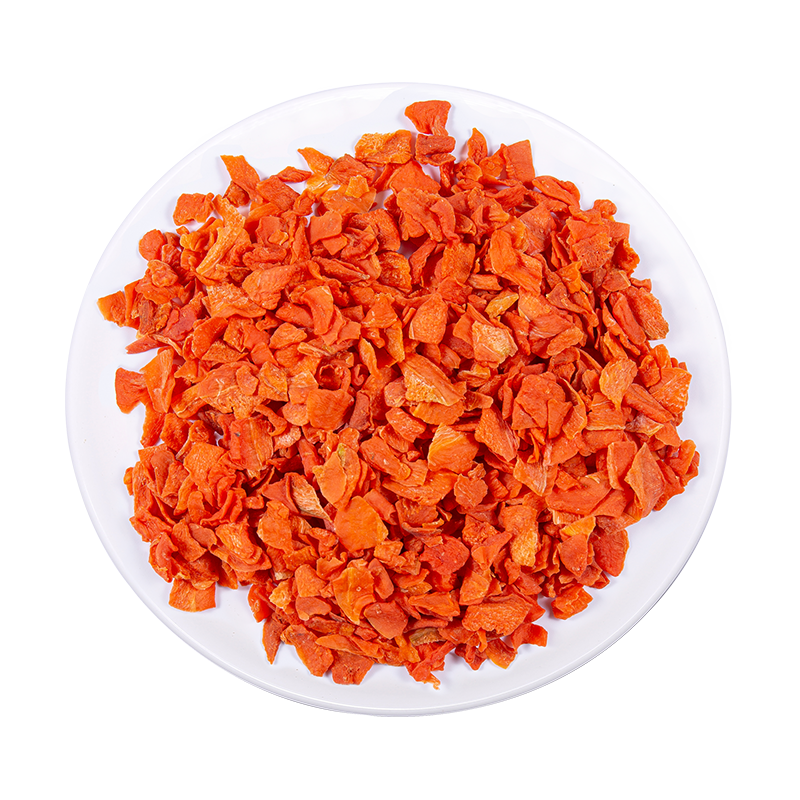
Particle size strongly determines how prone Dehydrated Carrot is to caking. Larger cuts such as cubes and flakes have relatively low surface area, meaning fewer contact points and minimal moisture absorption per unit weight. These physical attributes make them naturally resistant to caking, even under moderate humidity. In contrast, fine granules and powders exhibit high surface area and significant porosity. This promotes rapid moisture uptake and increases points of contact where adhesion can occur. The microstructure created by milling or grinding further exposes inner cellular surfaces, intensifying hygroscopic behavior. Powders also exhibit the “bridging effect,” where fine particles lock together mechanically in addition to chemically bonding via moisture-mediated adhesion. As a result, powders require stricter environmental controls and, in many cases, anti-caking agents. Meanwhile, flakes or larger pieces maintain stability over longer periods when exposed to less ideal storage conditions.
Influence of Drying Method on Anti-Caking Performance
The dehydration method used to produce Dehydrated Carrot dramatically influences its caking resistance. Air-drying, the most common method, creates denser structures with surface carbohydrates that may become sticky under humidity. Drum-drying breaks down cell structures more extensively, exposing sugars that accelerate hygroscopicity. Vacuum-drying often produces a more stable product by removing moisture at lower temperatures, thus minimizing sugar degradation and reducing stickiness. Freeze-drying offers the highest resistance due to its highly porous, brittle structure and extremely low moisture content; however, it is costly and can be fragile during mechanical handling. The microstructure produced by each method determines how the carrot interacts with moisture in the environment. In general, the more intact and less carbohydrate-exposed the surface becomes, the lower the tendency to form agglomerates. Therefore, selecting a dehydration method influences not only texture and appearance but also functional stability against caking.
Role of Packaging Materials and Barrier Properties
Packaging is one of the most decisive factors in preventing caking. High-barrier materials—such as aluminum foil laminates, metallized PET, and multi-layer polymer laminates—provide strong resistance against water vapor transmission. These barriers help maintain constant internal humidity levels regardless of external environmental fluctuations. Vacuum sealing or nitrogen flushing eliminates oxygen and reduces residual moisture levels inside the package, ensuring long-term stability. Conversely, low-barrier materials such as simple polyethylene bags allow moisture ingress through permeation, greatly increasing the risk of caking. Packaging design also matters: resealable zipper closures, heat-sealed edges, and thick material gauges contribute to better shelf-life performance. Industrial packaging (25–50 kg sacks or drums) often includes inner liners, desiccant packs, or oxygen absorbers to maintain low humidity. Without adequate packaging, even perfectly dehydrated product will eventually absorb moisture and cake.