English
 Français
 Español

Aug 25,2026
When it comes to clumping during storage, dehydrated red pepper is generally more prone to clumping than dehydrated green pepper, not less. This may seem counterintuitive, but it comes down to the higher residual sugar content and hygroscopic nature of red pepper compared to its green counterpart. Understanding why this happens — and how to manage it — is essential for buyers, food manufacturers, and home cooks who rely on consistent product quality.
Why Sugar Content Is the Key Factor
The primary reason dehydrated red pepper tends to clump more than dehydrated green pepper is its significantly higher natural sugar concentration. Red peppers are fully ripened versions of green peppers, and during ripening, starches convert into simple sugars. A typical red bell pepper contains approximately 4.2g of sugar per 100g of fresh weight, while a green bell pepper contains only around 2.4g per 100g — nearly half the amount.
When these peppers are dehydrated, moisture is removed but the sugars remain and become highly concentrated. Sugars, especially fructose and glucose, are hygroscopic — they readily absorb moisture from the surrounding environment. Once even a small amount of ambient humidity is absorbed, the sugar molecules on the surface of dehydrated red pepper pieces become sticky, causing particles to bond together and form clumps.
Dehydrated green pepper, with its lower sugar load, absorbs atmospheric moisture more slowly and bonds less aggressively, making it comparatively more stable under the same storage conditions.
Comparing Moisture Activity Levels
Another critical metric in understanding clumping behavior is water activity (Aw). Water activity measures how much free (unbound) water is available in a product, on a scale of 0 to 1. The lower the Aw, the more shelf-stable and clump-resistant a product generally is.
| Property | Dehydrated Red Pepper | Dehydrated Green Pepper |
|---|---|---|
| Natural Sugar (per 100g fresh) | ~4.2g | ~2.4g |
| Typical Water Activity (Aw) | 0.45 – 0.55 | 0.35 – 0.50 |
| Hygroscopicity | Higher | Lower |
| Clumping Tendency | More prone | Less prone |
| Recommended Storage RH | < 50% | < 60% |
As shown in the table, dehydrated red pepper tends to have a slightly higher water activity range under equivalent processing conditions. This means it reaches a critical moisture threshold — where clumping begins — faster than dehydrated green pepper when exposed to humid environments.
The Role of Cut Size and Surface Area
Beyond chemistry, the physical form of dehydrated red pepper also affects clumping behavior. Finely diced or powdered dehydrated red pepper has a much greater surface area-to-volume ratio than larger flakes or strips. More exposed surface means more opportunity for moisture absorption and inter-particle contact, which accelerates clumping.
- Dehydrated red pepper powder: Highest clumping risk due to maximum surface area and concentrated sugars.
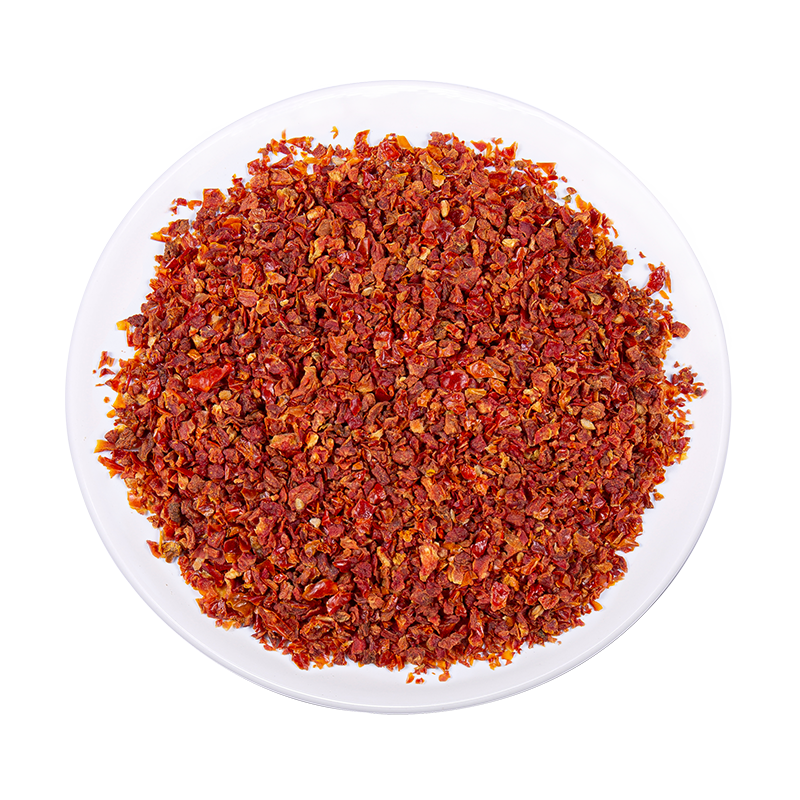
- Dehydrated red pepper diced (3×3mm or 5×5mm): Moderate clumping risk; most commonly used in industrial food production.
- Dehydrated red pepper flakes or strips: Lower clumping risk due to reduced contact points between pieces.
By contrast, dehydrated green pepper in the same cut size will typically exhibit less clumping, reinforcing that the composition difference — not just physical form — is a core driver.
How Processing Methods Influence Clumping in Dehydrated Red Pepper
Not all dehydrated red pepper is processed the same way, and the drying method plays a significant role in the final product's clumping behavior.
Air-Dried vs. Freeze-Dried Red Pepper
Conventional hot-air drying (AD) processes dehydrated red pepper at temperatures typically between 60°C and 80°C. This method can cause partial caramelization of surface sugars, which increases the stickiness of the final product and raises clumping risk. Freeze-dried red pepper, processed at sub-zero temperatures under vacuum, retains a more porous cellular structure and avoids sugar caramelization, resulting in a product that is less hygroscopic and less prone to clumping — though at a significantly higher production cost.
Impact of Final Moisture Content
Industry standards for dehydrated red pepper typically require a final moisture content of 8% or below, with premium grades targeting 6% or below. Products dried to the lower end of this range have considerably less free water available to facilitate clumping. When purchasing dehydrated red pepper in bulk, always request a Certificate of Analysis (COA) confirming both moisture content and water activity values.
Practical Storage Recommendations for Dehydrated Red Pepper
Given that dehydrated red pepper is more susceptible to clumping than dehydrated green pepper, proper storage is not optional — it is essential to preserving product quality and extending shelf life.
- Control relative humidity (RH): Store dehydrated red pepper in environments with RH below 50%. At RH above 60%, clumping becomes almost inevitable within weeks.
- Use moisture-barrier packaging: Multilayer foil bags with oxygen absorbers and desiccant packets are the industry standard for bulk dehydrated red pepper storage. Avoid standard polyethylene bags for long-term storage.
- Maintain cool temperatures: Storage at 15°C–20°C significantly slows moisture migration and sugar recrystallization. Avoid temperature fluctuations, which cause condensation inside packaging.
- Seal after every use: Exposure to air during repeated opening accelerates moisture uptake. Use resealable packaging or transfer product to airtight containers after opening.
- Consider anti-caking agents: For powdered or finely diced dehydrated red pepper in industrial applications, silicon dioxide (SiO₂) is a commonly approved anti-caking agent that can reduce clumping significantly without affecting flavor or color.
When Clumping Affects Product Usability
Minor clumping in dehydrated red pepper does not necessarily indicate spoilage. If the clumps break apart easily under light pressure and the product shows no signs of mold, off-odors, or discoloration, it is generally still safe and usable. However, in commercial food production — such as in seasoning blends, instant soups, or ready-to-eat meal kits — clumped dehydrated red pepper can cause dosing inconsistencies, block automated dispensing equipment, and negatively affect visual presentation in the final product.
For comparison, dehydrated green pepper under the same conditions is far less likely to cause such operational disruptions, which is one reason some food manufacturers deliberately choose dehydrated green pepper for high-humidity processing environments, even when the red variety is preferred for flavor or color in the final recipe.
If clumping resistance is a priority for your application, here is a quick reference guide for choosing between dehydrated red pepper and dehydrated green pepper:
- Choose dehydrated green pepper when operating in high-humidity environments or when using automated portion-control systems sensitive to clumping.
- Choose dehydrated red pepper when color, sweetness, and flavor profile are primary drivers, and you can implement proper humidity-controlled storage.
- Choose freeze-dried red pepper when clumping resistance and maximum flavor/color retention are both required, and budget allows for the premium cost.
- For powder applications, always specify anti-caking agents when sourcing dehydrated red pepper from suppliers, especially for retail packaging with long shelf-life requirements.
Dehydrated red pepper requires more careful storage management than dehydrated green pepper to prevent clumping. The investment in proper packaging, humidity control, and supplier-verified moisture specifications will protect product quality throughout the supply chain and ensure consistent performance in your end application.