English
 Français
 Español

Sep 15,2026
Dehydrated Potato Wins on Oxidation Stability, But Fat Content Is Nearly Equal
When comparing dehydrated potato to fresh potato, both contain naturally low fat levels — typically between 0.1% and 0.4% on a dry weight basis — making potato one of the lowest-fat staple crops available. However, the critical difference emerges during long-term storage: dehydrated potato, when properly packaged, demonstrates significantly superior oxidation stability compared to fresh potato. Fresh potato undergoes enzymatic and lipid oxidation within days to weeks, while well-processed dehydrated potato can maintain acceptable lipid quality for 12 to 24 months under optimal storage conditions. The processing method, packaging atmosphere, and storage temperature are the decisive factors.
Fat Content: How Dehydrated Potato Compares to Fresh Potato
Fresh potato contains approximately 0.1% fat by fresh weight, composed primarily of polar lipids (phospholipids and glycolipids) bound to starch granules and cell membranes. These lipids, though minor in quantity, play a disproportionately large role in flavor development and oxidative degradation over time.
In dehydrated potato products — including flakes, granules, and slices — fat content is measured on a dry weight basis and typically ranges from 0.2% to 0.5%, appearing slightly elevated due to water removal concentrating all components. However, when reconstituted to equivalent moisture levels, fat content is comparable to fresh potato.
The lipid profile of dehydrated potato includes:
- Linoleic acid (C18:2) — the primary unsaturated fatty acid, most susceptible to oxidation
- Linolenic acid (C18:3) — present in smaller amounts, highly prone to rancidity
- Palmitic acid (C16:0) — a saturated fatty acid, more oxidatively stable
- Phosphatidylcholine and phosphatidylethanolamine — membrane-bound polar lipids
It is these unsaturated fatty acids that are most relevant to oxidation stability discussions, as they are the primary substrates for lipid peroxidation reactions during storage.
dehydrated potato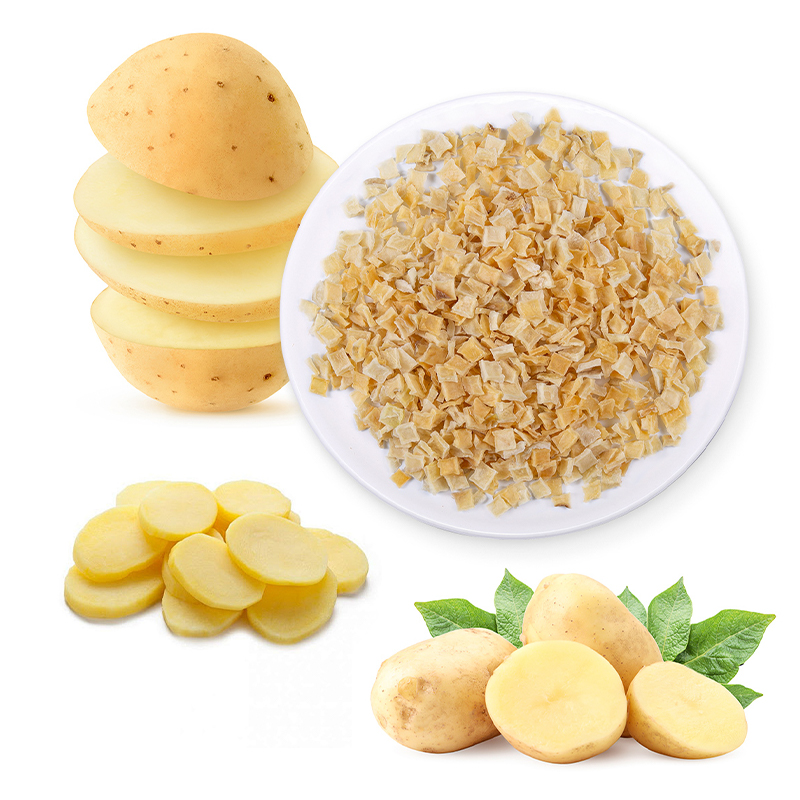
Oxidation Mechanisms: What Happens to Fat in Fresh vs Dehydrated Potato
Fresh Potato: Rapid Enzymatic and Oxidative Degradation
In fresh potato, two primary oxidation pathways operate simultaneously. First, enzymatic oxidation driven by lipoxygenase (LOX) rapidly degrades polyunsaturated fatty acids upon cell disruption — a reaction that begins within minutes of peeling or cutting. Second, non-enzymatic autoxidation proceeds through a free radical chain mechanism when potato tissue is exposed to oxygen, light, or elevated temperature. Studies have shown that fresh-cut potato stored at 4°C can exhibit measurable increases in malondialdehyde (MDA) — a lipid peroxidation marker — within 3 to 5 days, with peroxide values doubling within the first week of refrigerated storage.
Dehydrated Potato: Controlled but Present Oxidation Risk
During the dehydration process, heat inactivates LOX and other oxidative enzymes, effectively eliminating enzymatic oxidation pathways. However, the reduced water activity (Aw) environment of dehydrated potato — typically Aw 0.20 to 0.35 — creates a paradox: while low Aw inhibits microbial growth and some chemical reactions, it can actually accelerate non-enzymatic lipid oxidation at the monolayer moisture level (Aw ~0.20–0.30), as the protective aqueous phase diminishes. At Aw above 0.40, oxidation rates slow again due to dilution effects and free radical quenching by water molecules.
Quantitative Comparison: Oxidation Indicators Over Time
The table below summarizes key oxidation indicators comparing fresh potato and dehydrated potato under typical storage conditions:
| Indicator | Fresh Potato (7 days, 4°C) | Dehydrated Potato (12 months, 20°C) | Acceptable Threshold |
|---|---|---|---|
| Peroxide Value (meq O₂/kg fat) | 8–15 | 2–6 | <10 |
| TBARS / MDA (mg MDA/kg) | 0.8–1.5 | 0.3–0.7 | <1.0 |
| Hexanal (µg/kg) — rancidity marker | 120–300 | 30–90 | <150 |
| Water Activity (Aw) | 0.97–0.99 | 0.20–0.35 | <0.60 (microbial safety) |
| Usable Shelf Life | 7–21 days | 12–24 months | — |
Key Factors That Determine Oxidation Stability in Dehydrated Potato
Packaging Atmosphere
Oxygen is the single most critical driver of lipid oxidation in dehydrated potato. Nitrogen-flushed packaging reducing headspace oxygen to below 2% can extend oxidative shelf life by 40–60% compared to air-packed products. Modified atmosphere packaging (MAP) with oxygen absorbers is increasingly used for premium dehydrated potato products targeting shelf lives beyond 18 months.
Storage Temperature
Lipid oxidation rate approximately doubles for every 10°C increase in storage temperature (Q10 ≈ 2), following Arrhenius kinetics. Dehydrated potato stored at 10°C demonstrates peroxide value increases roughly four times slower than the same product stored at 30°C. This makes temperature-controlled warehousing a high-priority factor in supply chain management for dehydrated potato products.
Antioxidant Treatment
Many commercial dehydrated potato products incorporate antioxidant treatments during processing. Common approaches include:
- Sodium bisulfite or SO₂ dipping — inhibits both enzymatic browning and acts as an antioxidant; regulated at maximum 400–500 ppm in most markets
- Citric acid blanching — chelates pro-oxidant metal ions (Fe²⁺, Cu²⁺) that catalyze lipid oxidation
- Natural rosemary extract (carnosic acid) — increasingly used as a clean-label antioxidant, effective at 200–500 ppm
- Tocopherol (Vitamin E) addition — particularly relevant for drum-dried flake products
Drying Method Impact
The drying method significantly affects residual lipid integrity. Drum drying — used for most potato flakes — subjects the product to surface temperatures of 130–160°C for a brief contact time (20–30 seconds), which effectively inactivates LOX but can cause some thermal oxidation of surface lipids. Freeze drying, by contrast, preserves lipid structure most faithfully but leaves a highly porous matrix more susceptible to oxygen ingress after packaging is opened. Hot air drying at moderate temperatures (60–80°C) represents a balanced middle ground for sliced or diced dehydrated potato formats.
Practical Implications for Buyers and Formulators
For food manufacturers, industrial buyers, and procurement teams evaluating dehydrated potato, several practical conclusions follow from the oxidation stability data:
- Request oxidation certificates: Always ask suppliers for peroxide value and TBARS data at time of production and at projected end-of-shelf-life to confirm stability claims.
- Specify packaging requirements: For applications requiring shelf life beyond 12 months, specify nitrogen-flushed, oxygen-barrier packaging with oxygen absorber inserts.
- Monitor storage temperature: Warehouse dehydrated potato below 20°C wherever possible; storage at 25°C or above will substantially reduce effective oxidative shelf life even in sealed packaging.
- Evaluate antioxidant declarations: If clean-label positioning is required, confirm that rosemary extract or tocopherol — rather than synthetic BHA/BHT or sulfites — is used as the antioxidant system.
- Conduct accelerated shelf-life testing (ASLT): For new product development, conduct ASLT at 40°C/75% RH over 4–8 weeks to model 12–24 month ambient storage behavior before launch.
Despite having a nearly identical fat composition to fresh potato, dehydrated potato demonstrates dramatically superior oxidation stability over extended storage periods. The elimination of enzymatic oxidation pathways through heat processing, combined with low water activity and controlled packaging atmospheres, allows dehydrated potato to maintain lipid quality well within acceptable thresholds for 12 to 24 months — a timeline impossible for fresh potato to match. The practical advantage for supply chain resilience, food manufacturing consistency, and ingredient quality assurance is substantial. When purchasing dehydrated potato, verifying the oxidation control measures — packaging atmosphere, antioxidant system, and storage temperature specifications — is essential to realizing this oxidative stability advantage in practice.